
Robot hardware circuit design is a core part of the development of service robots, industrial AGVs, inspection robots and humanoid robots. A complete robot BOM covers multiple circuit modules including main control, sensing, motor drive, industrial communication, power management, security and storage. When selecting components for robot solutions, many hardware engineers focus on the parameters, supply availability and alternative options of robot chips, domestic MCUs, robot sensor chips, motor drive chips and industrial bus chips. Below is a breakdown of commonly used chip types and mainstream brands for robot circuit design by module.
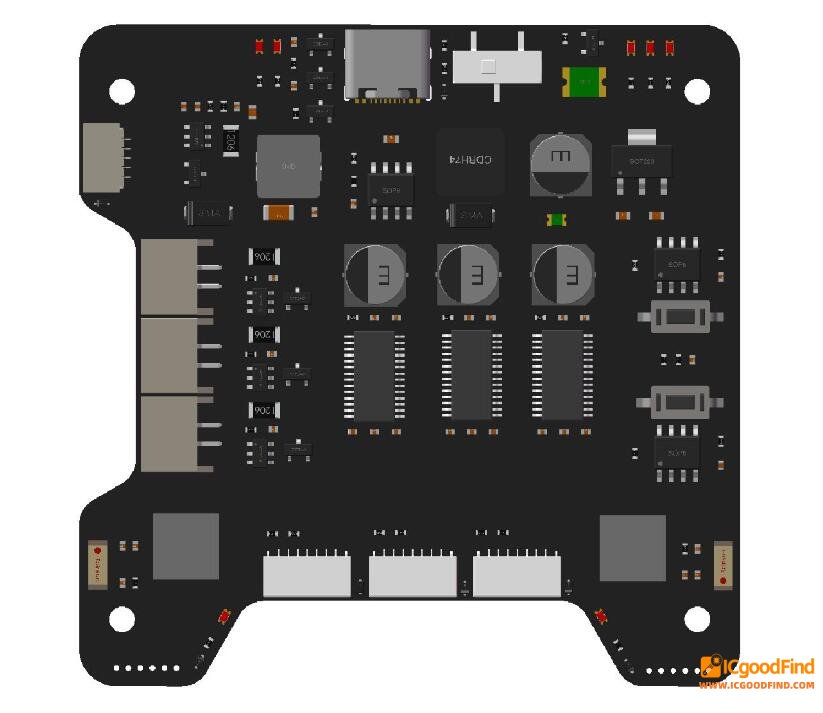
The main control circuit serves as the computing hub of the robot, handling task scheduling, peripheral management, AI inference, video processing and logic control. It is divided into high-performance SoCs and general-purpose MCUs. High-performance SoCs are suitable for robots with machine vision and AI computing. Multi-core SoCs from Rockchip and Allwinner are widely adopted with mature Linux ecosystems, commonly used on vision mainboards for inspection robots and service robots. General-purpose MCUs are deployed for lower-computer control, IO acquisition and chassis closed-loop control. GD32 from GigaDevice, APM32 from Geehy, N32 from Nations and STM32 series from STMicroelectronics are the most popular main control chips for industrial and consumer robots. ESP-series Wi-Fi+Bluetooth SoCs from Espressif are used in wireless communication subcircuits to realize robot network access and remote debugging.
The sensing circuit collects posture, position and environmental signals, forming the foundation for robot positioning and obstacle avoidance. It consists of MEMS sensors and precision analog front-end devices. IMU accelerometers and gyroscopes from Bosch and STMicroelectronics are widely used in attitude solving circuits to obtain robot tilt angle and angular velocity. Hall and magnetic sensors from Honeywell are applied for limit detection and position sensing. For signal conditioning, INA series precision instrumentation amplifiers from TI, together with operational amplifiers from SGMICRO and 3PEAK, amplify weak sensing signals and implement motor current sampling. They improve signal-to-noise ratio and reduce interference from noise on sampling circuits, which are common analog front-end components for robots.
The motion control circuit is the power core of the robot, including control computing units, gate drivers and power devices. It supports FOC closed-loop control for stepper motors and BLDC servo motors. For multi-axis high-precision servo applications, TMS320F series DSPs from TI deliver excellent floating-point performance and fit complex motion control algorithms. High-performance MCUs from STMicroelectronics, Geehy and Nations come with abundant PWM timers for medium and low-power motor control circuits. Power driver chips from Chipown are matched with motor power boards to complete voltage conversion and drive output, acting as key components in power loops. The selection of robot motor drive chips directly affects the running stability of robot chassis.
Industrial robots and AGVs widely adopt isolated CAN and RS485 buses between the main controller and servo drives. Communication circuits have strict requirements on isolation voltage, anti-interference capability and EMC performance. CAN transceivers from Infineon and NXP feature high reliability and are suitable for industrial scenarios with complex electromagnetic environments. Isolated interface chips from Chipsail are preferred domestic alternatives for bus isolation. Many MCUs integrate built-in CAN, SPI and I2C peripherals, which can simplify peripheral circuits, shorten the BOM list and reduce the difficulty of robot communication circuit design.
The power supply circuit provides multi-channel voltage regulation for all boards of the robot. Ripple and conversion efficiency of power chips directly determine the long-term operation stability of robots. DC-DC buck chips from CoreChips are widely used in multi-channel power supply circuits to feed main controllers, sensors and communication modules. Combined with LDOs and voltage references, they supply low-noise power to analog sensing circuits. Power design needs to separate power supply and analog power domains with proper ground segmentation to avoid interference from power loops on signal acquisition. Power chips are indispensable categories in robot hardware BOMs.
Storage chips store firmware, parameters and operation logs. Security chips are used for firmware encryption and device authentication to prevent program cracking and piracy. Security chips from Huada Semiconductor and Fudan Microelectronics are commonly deployed on security subcircuits of main control boards. FPGAs from Fudan Microelectronics can be used in high-end robot solutions to expand logic interfaces and implement high-speed parallel signal processing, meeting the requirements of high-spec robot projects.
For consumer robot circuit design, priority is given to cost, development documentation and mass production maturity. For industrial AGV and humanoid robot solutions, wide-temperature range, vibration resistance and EMC indicators are more critical. Many projects adopt a mixed BOM with domestic and imported chips to balance supply chain risks. At the R&D stage of robot solutions, engineers need to compare chip parameters and evaluate reference circuits, supply cycles and device compatibility to complete component selection planning.
#ICGOODFIND During robot circuit R&D, BOM sorting and trial production, engineers often need to check robot component datasheets, verify part numbers, search stock and source alternative domestic parts. The ICGOODFIND platform gathers main control, sensor, motor drive, industrial communication, power and security chips for robot applications. It supports BOM quotation, component parameter inquiry and sourcing of hard-to-find parts, helping robot hardware engineers efficiently finish component selection and supply chain coordination.
#robotcircuitdesign #robotchips #robotelectroniccomponents #domesticMCU #domesticMCU #motordrive chips #industrialbuschips #robotBOMquotation #componentselection #domesticchipreplacement
